
Overview
A practical, no-hype comparison for businesses weighing up their next productivity platform.
Every growing business has this conversation at some point: Should we be on Microsoft or Google Usually it comes down to
personal preference Gmail fans on one side, Excel loyalists on the other. But the better question isnt which one people like.
It’s which ecosystem actually supports the way your business needs to grow.
Key takeaway
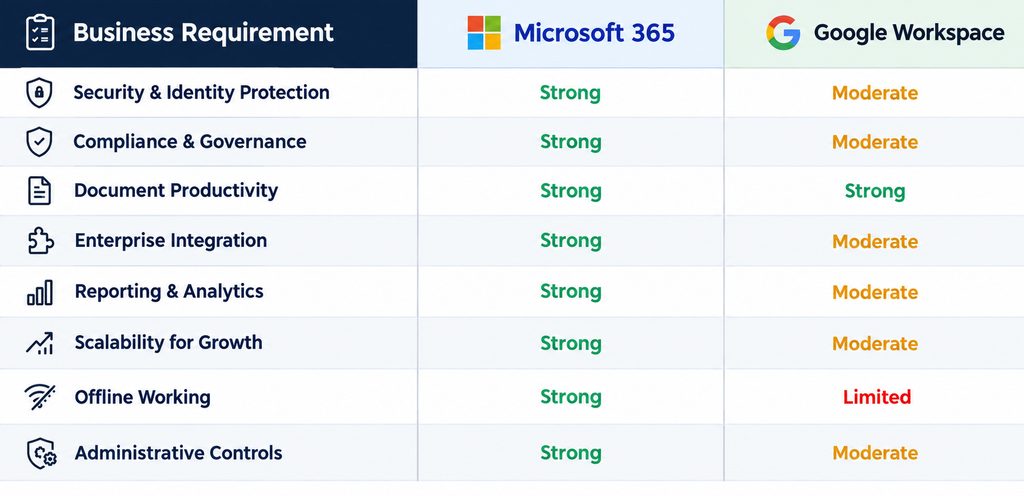
- Microsoft leads in security & compliance
- Better suited for regulated industries
- Stronger ecosystem integration
- More scalable for enterprise growth
The tools people use every day
Google Workspace is fast, clean, and easy to pick up – Docs, Sheets, and Slides live in the browser and make real-time
collaboration effortless. Microsoft 365 takes a different approach: Word, Excel, and PowerPoint carry decades of refinement,
and it shows once work gets complex – detailed models, long contracts, boardroom-ready presentations. They also work fully
offline, which matters more than people expect. For businesses built on detailed reporting or client-facing documents,
Microsoft’s tools tend to carry more weight.
Security – where the gap gets harder to ignore
Google Workspace offers solid, straightforward baseline security – fine for simple needs. Microsoft is built for a different level
of risk: Defender, Purview, and Entra ID work together to cover identity, devices, data, and compliance in one connected
system. For businesses handling sensitive client data or operating in regulated industries, that depth is hard to overstate – and
security shouldn’t be an afterthought bolted onto a productivity decision.
How well it connects to everything else
Most businesses aren’t just picking an email platform – they’re picking the foundation everything else sits on. Microsoft 365
connects naturally into Teams, SharePoint, Power Platform, and Azure, so the pieces fit together as a business grows. Google’s
ecosystem works well for lean, cloud-native teams, but as complexity grows – more departments, more compliance, more
systems talking to each other – Microsoft’s connected approach tends to reduce friction rather than add to it.
Support that scales with you
A platform is only as good as the support behind it. Microsoft’s global partner network, including specialists like Teckonnect,
means businesses aren’t left figuring out rollouts or security configurations alone – there’s expertise available that understands
both the platform and the business it’s being deployed into.
Where this leaves you
There’s no universally “correct” answer – plenty of businesses run happily on either platform. But for businesses handling
sensitive data or expecting to scale over time, Microsoft 365 consistently offers the deeper toolkit and stronger safety net.
As a Microsoft Solution Partner, this is exactly where our team spends its time – helping businesses set up, secure, and get
genuine value from their Microsoft environment. If you’re weighing up this decision, we’re happy to talk through what it would
actually look like for your team.
Conclusion
Microsoft is generally the stronger option for organizations requiring:
- Security
- Compliance
- Governance
- Long-term scalability
Google remains a strong platform for simplicity and collaboration
“For businesses managing compliance, security, and long-term growth, Microsoft’s ecosystem often provides the
stronger foundation.”